Ee
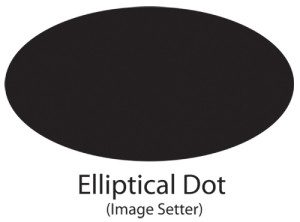
Elliptical Dots: Elongated or Oval shaped dots used in halftone printing. A 70/30 elliptical dot (image shown to the left) is a typical elliptical dot that aids in the imaging process to capture the halftones. Elliptical Ink Jet shaped dot graphic image shown to the right below.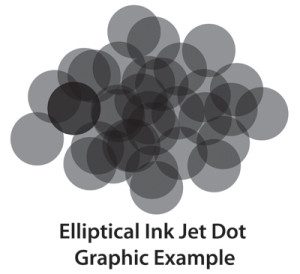
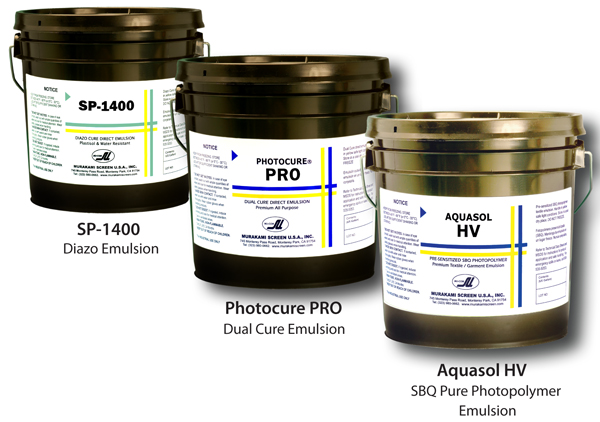
Emulsion: A photosensitive liquid that is applied to a screen to produce a stencil for print making. Emulsion falls into 3 categories. Diazo, Dual Cure, and Pure Photopolymer. Click on image below to view emulsions.
Epoxy: A solvent based ink used for printing on substrates when a durable print is required. Usually a 2 part system using catalyst to achieve strong print images.
EPS (Encapsulated Postscript): An electronic file format that utilizes Post Script file format for imaging purposes.
Exposure: Exposing an emulsion to light on a coated screen to create a stencil for printing. The light must have sufficient UV output to achieve proper exposure. Screen durability is affected by the quality of the exposure which is determined by the quality of the UV light used to expose the screen.
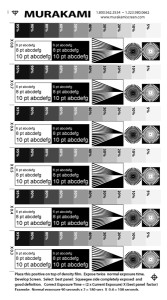
Exposure Calculator: A device used to determine the best exposure time for a specific emulsion to create a durable stencil. Typically this is a 2 film process with a detailed screen image taped to the screen and a density film with different densities placed over the top of the first film. This process yields 6-8 exposures depending on the calculator with one test exposure. The estimated time is doubled for an exposure calculator test. The panel with the best durability is and resolution is chosen visually. Each density panel has a factor number. The best quality panel’s factor is multiplied by the overall time in seconds or light units to determine the exposure time. Ex: 120 seconds X .5 (panel factor) equals 60 seconds. View image below of Murakami Exposure Calculator.
Exposure Unit: There are two main types. Enclosed and free standing. Enclosed units can be used in the screen storage area, free standing units cannot. Both will use a vacuum frame to press the positive against the emulsion completely. There are many different types of exposure units. Fluorescent tubes, Metal Halide and Mercury Vapor. The strongest units have 5,000 watts or higher lamp strength. Lamps can also vary in the type of UV light they output and can be configured for diazo or pure photopolymer emulsions. The strongest screens come from strong UV light sources with a multi-spectral bulb.
Extender Base: Used to extend ink in the form a colorless ink additive. There are many different types. Clear Extender, Opaque Extender, Soft Hand Extender, Stretch Additive, Halftone base extender and Water base extenders.