It’s what you can’t see that matters.
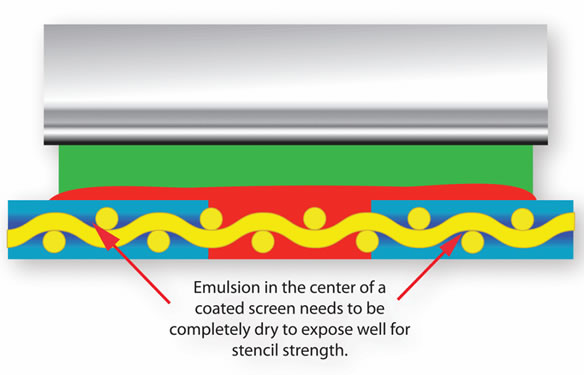
Screen room personnel often fall into a repetitive cycle in screen making. Handling screens becomes a constant work pattern where little thought is given to the condition of the emulsion, the screen room, the exposure process, or the condition of their equipment and the presses. They are constantly in a production ‘pinch point’ where a finite amount of screens can be processed through their area. Between sampling needs, production, and replacement screens for any that have broken down in production, they often aren’t aware of anything but the need to line up the art and get another screen shot. They work at near capacity throughput for their system. Screens that are made in a hurry and rushed to production often look identical to any other screens. They are coated the same way, the exposure is the same time, the blockout and tape job are identical. One screen may last thousands of prints while one rushed to a press may breakdown in 300-500 prints. Same emulsion, same exposure time, same personnel yet some screens work well, some breakdown. The faster they go the more issues production has on press. So what is wrong with this picture? How can we change the process to make life easier for everyone in the shop, and with this process improve profits and company stability? The problem with the above scenario is this: the screen issues cannot be seen with the naked eye. It’s what we don’t see that causes most of the problems. So let’s look at areas that we find are often neglected in the screen room. Click here to continue reading the article: It’s What You Can’t See That’s Important
For more information and specifications on using Murakami products in production please contact our Technical Support Representatives available Monday through Friday 8am to 5pm PST at: (323) 980-0662